
In our house, every time we call “screens off”, the negotiation begins — and that’s exactly why I want to share simple, practical screen time boundaries for kids that actually work.
Because somehow — somehow! — every episode has exactly five minutes left.
It doesn’t matter if they started it ten minutes ago, or if the episode is actually 22 minutes long and they’ve been watching it. It doesn’t matter if I literally watched them press play with my own two eyes.
Nope. When we call time, some mysterious childhood superpower activates and—
“But I only have five minutes left…”
At this point, I’m convinced there’s a secret union of children who all carry the same negotiation handbook titled:
“How To Negotiate More Screentime” — Chapter 1: The Five-Minute Miracle.”
Still, behind the scenes and our kids’ impressive commitment to dramatic arts, Christian parents are asking a very real question:
How do we raise kids who can handle technology with wisdom…while we handle parenting with grace?
The truth is, screens aren’t going anywhere. But neither is our calling to shepherd our children’s hearts. And if you ever feel like you’re learning as you go, you might like my post on grace-filled parenting.
With that in mind, that question pushed me to do some digging, because truly, friends, you’re in good company—this is a very real challenge for us, too.
If you’ve ever taken away a device and your child acted like you canceled Christmas, deleted Minecraft, and ruined their social life in one keystroke…
You’re in the right place.
On one hand, screens are
- a gift.
- a curse.
- the reason we get 15 minutes of quiet so we can cook dinner.
- the reason dinner burns.
It’s complicated.

Yet at the same time, God gives us something screens don’t: wisdom.
And also the ability to turn things off. Which brings us to the heart of it: boundaries matter.
Why Screen Time Boundaries for Kids Matter
The Bible doesn’t mention iPads, Netflix, YouTube Shorts, or the infinite black hole that is Pinterest — but it does give us a framework for living wisely in a world full of distractions.
When we set screen time boundaries for kids, we’re not being mean — we’re shaping hearts.

For example, Paul writes:
“Everything is permissible for me, but not everything is beneficial.” — 1 Corinthians 6:12
This is the same principle we cling to in so many areas of our home — especially when it comes to disciplining with wisdom and peace.
In other words, technology itself isn’t evil. It’s a tool. A powerful one. It can help us teach, calm, connect, and even disciple our kids.
On the other hand, it can also overwhelm, distract, and slowly rewire their hearts.
Screens tug at the same three things that the Bible warns us about:
- the lust of the eyes —constant entertainment
- the lust of the flesh —instant gratification
- and the pride of life —comparison, performance, attention
It’s not about control — about formation
Formation of habits, attention, character, and ultimately: love.
At the end of the day, our goal isn’t to create tech-free children. Our goal is to raise Christ-shaped kids in a tech-shaped culture. And that takes wisdom, intention, and yes… the repeated breaking of the-“five more minutes”-spell.
Biblical Anchors: Wisdom, Stewardship, and Care
“...I will not be dominated by anything.” — 1 Corinthians 6:12
We’re not anti-screen. However, we are anti-dominated.
Screens are
- permissible
- fun
- educational
But screens cannot be the boss.
Practical Screen Time Boundaries for Kids
Clear Start-and-End Times
Think of screen time like a flight. Planes don’t take off without a schedule or at least they shouldn’t.

Try:
- “You have 30 minutes.” Set the timer and stick to it.
- “You can watch one episode.” No “five more minute” loopholes.
- “Screens go off at 4:00.” Make it predictable.
Use a visible timer they can’t argue with. Kitchen timers and oven timers don’t take offense. Hand the responsibility over to the timer: “Ask the timer, sweetheart — it doesn’t lie.” This removes bargaining and models consistent boundaries.
Kids thrive with clarity, even if they claim they don’t.
You are not a restrictive tyrant. You are a shepherd. God calls parents to actively shape their children—not hand them over to screens.
“Teach them diligently… talk of them when you sit… walk… lie down… rise.” Deuteronomy 6:6–7
Screens often replace the very moments God calls discipleship to happen.
"Bring them up in the discipline and instruction of the Lord." Ephesians 6:4
Instruction takes presence. Presence takes time, and time gets eaten by screens.
Remember, you’re not fighting your kids. You’re fighting for their future discipleship.
A simple rule: Philippians 4:8 as a media filter

- Is it true?
- Honorable?
- Right?
- Pure?
- Lovely?
- Excellent?
- Praiseworthy?
If a show fails the test, it fails the test. Even if “everyone else watches it.”
Not everything online is good for your heart.
—Grace
Kids can understand discernment far earlier than we think.
Tech-Free Zones That Protect Hearts
These are places where screens don’t get to come:
- The dinner table
- Bedrooms
- Devotional / Bible time
- Family night
As a result, when kids know certain spaces are unplugged, their hearts learn to rest in them.
We’ve found that slowing our home life helps a ton here too — simple practices like baking together or resetting rhythms (I shared more about that in my easy homemade bread recipe story).

The Heart Behind Screen-Time Boundaries
Small choices that build bigger habits
At the end of the day, our screen-time boundaries aren’t ultimately about controlling behavior.
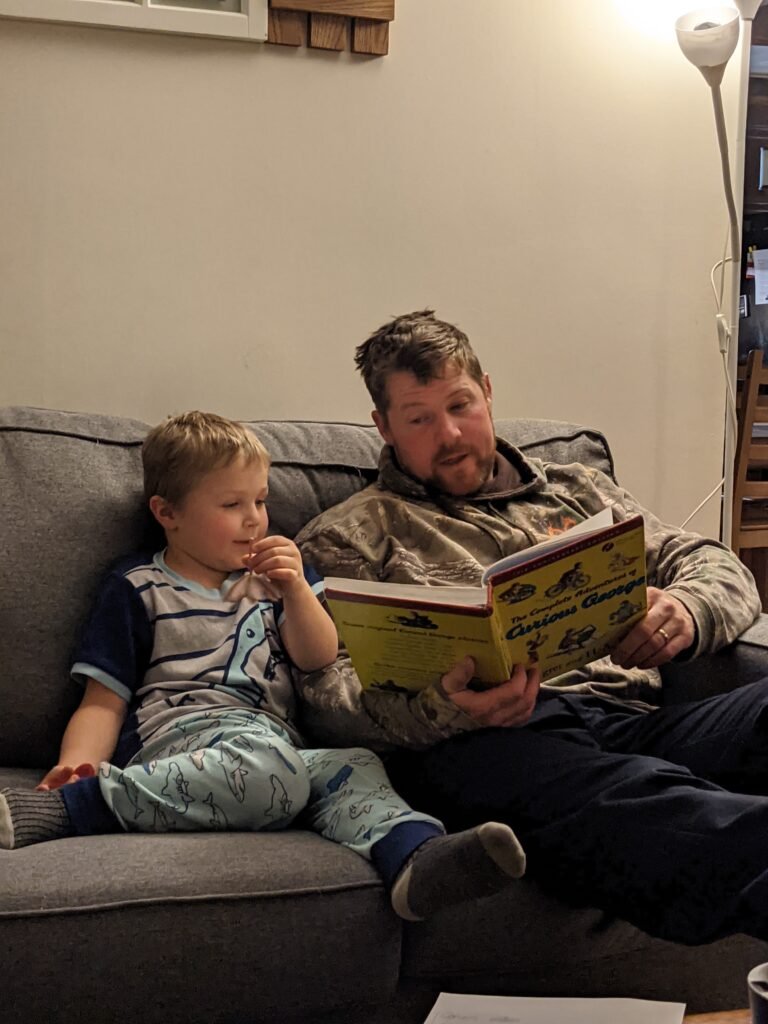
They’re about shaping the heart:
- Hearts that value presence over distraction.
- Hearts that understand self-control is a fruit of the Spirit.
- Hearts that know God deserves our first love, not our leftover attention.
- Hearts that learn the joy of choosing what is beneficial, not just what is available.
If this resonates, you may also enjoy my reflection on finding peace in spiritual winter, where I talk about nurturing faith in slow seasons.
Final Encouragement — You’re Doing It Right
Jesus doesn’t tell us to raise perfect children—He tells us to raise discipled ones.

And thankfully, He equips us with:
- wisdom:
 “If any of you lacks wisdom, let him ask of God, who gives generously to all without reproach, and it will be given him.”

James 1:5
- grace :
 “But He said to me, My grace is sufficient for you, for my power is made perfect in weakness.”

2 Corinthians 12:9
- peace :
 “And let the peace of Christ rule in your hearts, to which indeed you were called in one body.”

Colossians 3:15
- strength:
 “But they who wait for the Lord shall renew their strength…”

Isaiah 40:31
Practically speaking, when we set boundaries, we’re not restricting our kids. We’re inviting them into what’s real. We’re helping them taste a life that’s deeper than pixels, louder than notifications, and richer than any storyline YouTube could produce.
Even so, if along the way they still insist “It’s just five minutes…!” We can smile, breathe, and remember: We’re not just teaching them how to manage screens. We’re teaching them how to manage life.
Are they still dramatic afterward? Yes. Will they survive? Also yes.
Will they claim you have ruined their entire childhood? Most definitely.
Congratulations — you’re doing it right.
And with God’s grace — and maybe a very reliable kitchen timer —we’ll get there.
We’re not trying to make kids screen-free. We’re trying to make them free, period.
—Grace

I had to laugh at this…Ruben will come to me and ask to watch a show declaring that there is “only 5 minutes left” because he has heard the bigger kids say that so many times, lol! He obviously has no idea what that means except it must be what you have to say in order to watch just a little longer!